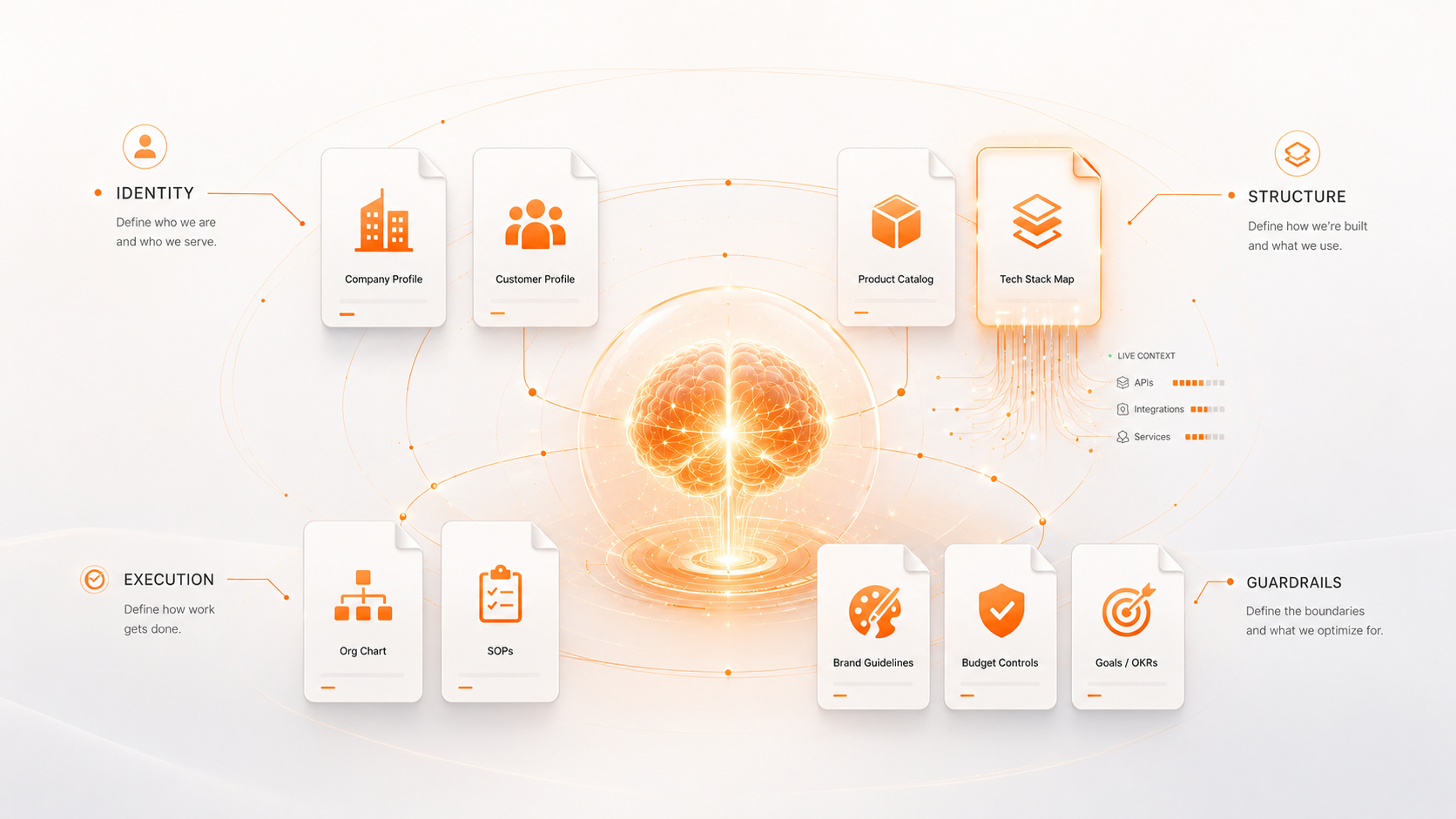
So I built a Claude skill that walks you through creating that context for your own company. You download it, run it, answer some questions, and you come out the other side with ten real documents that give your agents a brain.
The skill groups them into four jobs: identity, structure, execution, guardrails.
Identity. Company Overview (what you sell, who to, model, stage, metrics). ICP and Customer Profile (who buys, who's a bad fit, the objections). Product and Service Catalog (offerings, pricing, and crucially what you don't do).
Structure. Tech Stack Map (every tool, owner, cost, renewal). Org Chart and Roles (who does what, who signs off).
Execution. SOPs (your recurring processes, step by step). Brand and Voice Guidelines (so agent output sounds like you, not like every other ChatGPT wrapper).
Guardrails. Financial and Budget Context (thresholds, approvals, hard limits). Policies and Compliance (what data is sensitive, what never gets automated without a human). Goals and OKRs (what winning looks like this quarter).
9 of these you write once and update when things change. The 10th changes every week whether you update it or not. More on that below.
How the skill actually works
It profiles your company first. Industry, headcount, stage, and which agent use case is most urgent. Then it goes document by document. For each one it asks a few sharp questions, drafts the doc from your real answers, shows it to you, and asks if it matches reality. You correct it, it refines, and only then does it move on.
That's the loop. Question, draft, refine, confirm, next. It tailors as it goes, so a healthcare company gets patient-data policies, a fintech gets regulated-spend guardrails, and a five-person agency doesn't get the SOPs of a ninety-person company. If you only have time for the three docs your urgent use case needs, it builds those properly instead of all ten badly.
At the end it assembles everything into one pack you can keep. That pack is the brain.
The one document you should never maintain by hand
Document 4 is the tech stack map. This is the one everyone gets wrong.
A stack spreadsheet is dead the moment you save it. You think you have 40 tools. You have 140. You think marketing owns Canva. Three teams expense it separately. A seat is quietly billing hundreds a month and nobody noticed.
So the skill doesn't tell you to build a spreadsheet. It invites you to connect your stack to ELI.
ELI runs on an MCP server. Inside the skill, when you hit document four, it gives you the connection steps directly: add the server at https://mcp.techbible.ai/mcp under Settings, Connectors, Add custom connector, then authenticate. Once it's connected, the skill pulls your live stack and builds the document from real data. Spend, owners, renewals, redundancy, ROI, all current the moment an agent asks.
That's the difference between an agent that says "I think you use a CRM" and one that says "you're paying for two tools tagged CRM, one is redundant, here's the renewal date." When the context is live, the agent stops guessing and starts acting.
If you'd rather not connect it yet, the skill builds the static version and tells you straight that it'll go stale. The live version is there whenever you're ready.
Go build your brain
Identity, structure, execution, guardrails. Write nine once. Keep the tenth live.
Download the skill, run it in Claude, and in about twenty minutes you'll have the context your agents have been missing this whole time.
Your agents are only as smart as the context you give them.
Give them a brain worth using. 🦅