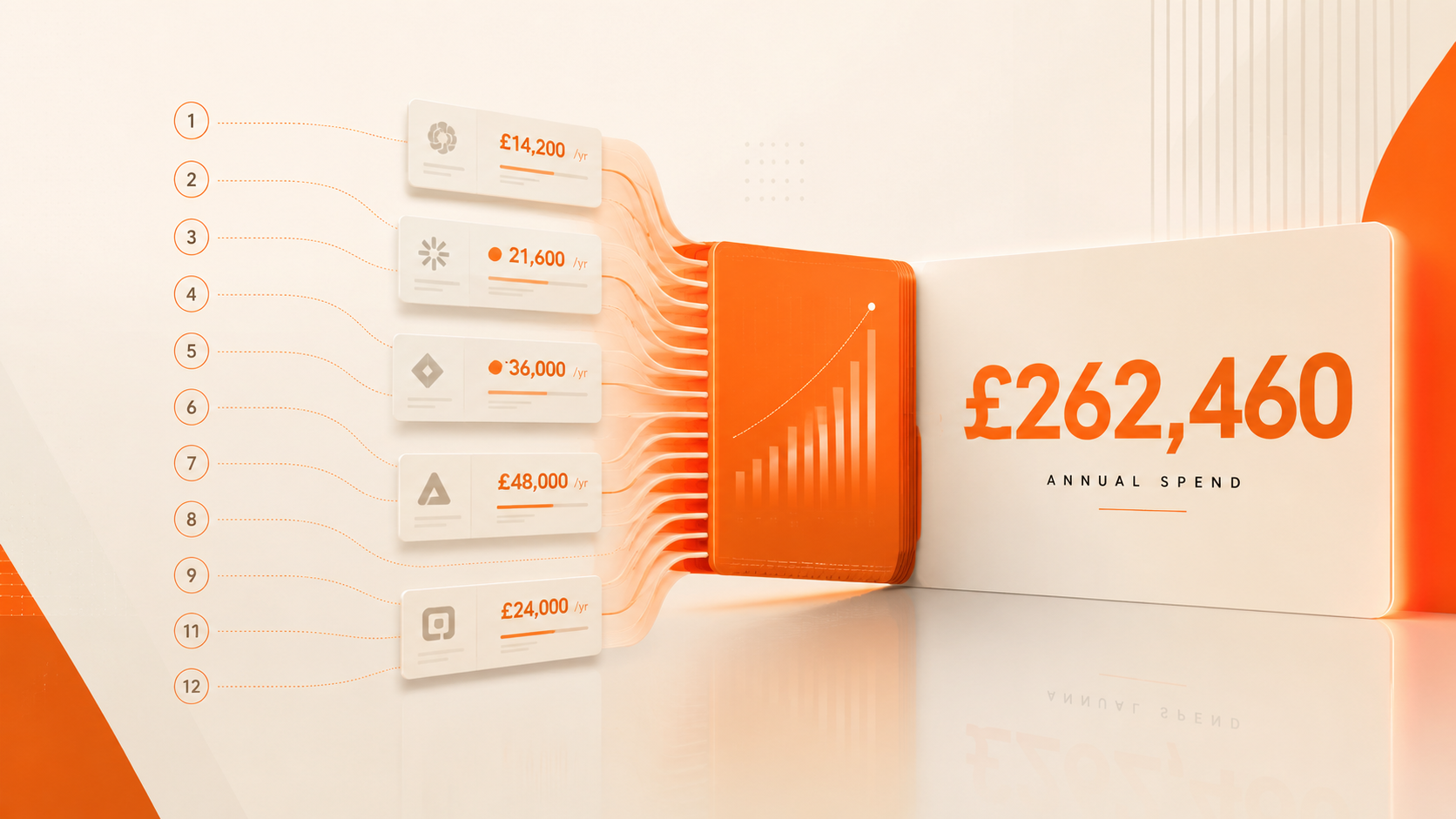
The short version: your company is vibe spending when teams buy software, models and AI agents because they feel useful, but nobody can show one live view of the owner, cost, usage and output.
It does not look reckless. It looks fast.
Sales adds an AI prospector. Marketing tests three video generators. Engineering puts model credits on a card. Operations buys another automation platform because the first one belongs to a different team. Every purchase is individually defensible. The stack they create together is not.
That is vibe spending: technology spend without shared context or continuous accountability.
The cost is bigger than the invoice. It includes unused seats, overlapping capability, surprise usage bills, duplicated work, security exposure and hours spent finding out what the company already owns.
This guide gives you 12 signs to look for, a simple way to calculate what each one costs, and the first action to take.
Important: the figures below are worked examples for a 100-person company, not universal benchmarks. Replace them with your own contracts, usage and loaded salary costs. Each formula is included so the maths can be checked.
What is vibe spending?
Vibe spending is the uncontrolled purchase or use of software and AI without a named owner, an agreed budget, reliable usage data or a measurable business outcome.
Traditional SaaS waste was mostly about licences. Agentic AI adds variable token and compute costs, autonomous activity and output that is harder to measure. A £20 seat can become a gateway to uncapped consumption. A free experiment can quietly become production infrastructure.
ELI calls this an AI workforce with no payroll system. The phrase fits because every human employee has a manager, a cost centre, access controls and a reason for being there. Your agents should too.
Vibe spending cost calculator: the 12 signs at a glance

Illustrative total: £262,460 a year. Do not simply add your own figures without checking for overlap. One unused licence may also appear inside a duplicate contract, so a proper audit should deduplicate the savings.
1. Nobody can produce a complete software and AI inventory
Ask Finance, IT and department heads how many tools the company uses. If you get three different answers, you have sign number one.
Invoices show what was paid. SSO shows some logins. Browser activity shows usage. Email contains receipts and trials. No single source tells the whole story.
What it costs: forgotten renewals plus the labour required to reconstruct the stack.
Formula: untracked annual spend × avoidable waste rate + monthly discovery hours × loaded hourly cost × 12
Example: £60,000 of untracked spend × 15% + 10 hours a month × £43.33 = £14,200 a year.
First move: connect accounting, company email and browser or identity data. Build one live inventory before trying to optimise anything.
2. Tools and agents do not have named owners
If the answer to “who owns this?” is a department, nobody owns it.
A real owner can explain why the tool exists, who uses it, what it replaces, when it renews and which result justifies the bill. This matters even more for agents: someone must own the budget and the output, not just the prompt.
What it costs: ownerless spend that survives by inertia, plus time lost during renewals and incidents.
Formula: ownerless annual spend × waste rate + incident hours × loaded hourly cost
Example: £50,000 × 25% + 40 hours × £50 = £14,500 a year.
First move: assign one accountable human, one cost centre and one review date to every paid tool, model and agent.
3. Different teams pay for tools that do the same job
Marketing uses one project manager. Product uses another. Sales has a third “because it integrates with the CRM.” The names differ; the job does not.
The obvious duplicates sit in the same category. The expensive ones hide across categories: a CRM, support platform and data tool may all include overlapping enrichment, automation and reporting features.
What it costs: the contract value of capability you already bought elsewhere.
Formula: duplicate seats × monthly seat price × 12 + duplicate platform fees
Example: 60 seats × £20 × 12 + £7,200 in duplicate platform fees = £21,600 a year.
First move: compare tools by the tasks teams actually perform, not by vendor category.
4. Leavers still have licences — or access
Offboarding often stops at payroll and email. Paid seats remain active. API keys keep working. Agents created by former employees continue running.
This is not only licence waste. It is an access-control problem with a monthly fee attached.
What it costs: inactive seats, residual usage and the expected cost of access risk.
Formula: orphaned seats × monthly cost × 12 + residual usage + risk allowance
Example: 24 seats × £40 × 12 = £11,520 a year, before assigning any value to security exposure.
First move: trigger licence reclamation, token rotation and agent review directly from the offboarding event.
5. AI usage has no budget ceiling
The team watches subscriptions but ignores API keys, model routing, credits, inference, storage and agent loops. That is like approving salaries but refusing to look at overtime.
Variable pricing is not the problem. Unowned variable pricing is.
What it costs: the gap between planned and actual consumption.
Formula: actual monthly AI usage − approved monthly AI budget, multiplied by 12
Example: (£8,000 − £5,000) × 12 = £36,000 a year.
First move: set budgets and anomaly alerts by team, workflow, model and agent — not only by vendor account.
6. Nobody can connect agent spend to agent output
Your dashboard shows tokens. It does not show resolved tickets, qualified leads, accepted pull requests or hours returned to the team.
Tokens are a consumption metric, not an outcome. Cheap tokens attached to useless work are still waste. Expensive reasoning attached to a high-value result may be excellent economics.
What it costs: any agent spend that cannot be tied to a verified result.
Formula: annual agent cost × percentage of output that is unmeasured or unused
Example: £80,000 × 60% = £48,000 a year at risk.
First move: give every production agent one output metric, one quality threshold, one owner and a cost per accepted outcome.
7. Every department negotiates on its own
Three teams can buy the same vendor under different contracts, at different prices and on different renewal dates. The vendor sees one customer. You behave like three.
What it costs: lost volume discounts, inconsistent terms and repeated procurement work.
Formula: consolidatable annual spend × achievable discount + duplicated negotiation hours × hourly cost
Example: £120,000 × 15% + 120 hours × £50 = £24,000 a year.
First move: consolidate vendor identity across cards, invoices, legal entities and product names before the next negotiation.
8. Renewals arrive as surprises
If the first renewal alert is the charge, the decision has already been made for you.
Auto-renewal removes your leverage. By the time Finance sees the payment, the tool may be locked in for another year even if usage has collapsed.
What it costs: avoidable contract value renewed without evidence.
Formula: renewed contract value × removable or renegotiable share
Example: £60,000 × 30% = £18,000 a year.
First move: start the usage and owner review 90 days before renewal, not nine days before.
9. Free trials quietly become production infrastructure
A team starts with a free tier, builds a workflow around it, adds customer data, then discovers the controls it needs live behind an enterprise contract.
The tool was free. The dependency was not.
What it costs: emergency upgrade premiums, migration work and operational interruption.
Formula: unplanned annual premium + migration hours × loaded hourly cost + downtime cost
Example: £9,000 premium + 120 hours × £51 = £15,120, excluding downtime.
First move: review security, exportability, expected scale and paid-tier economics before a trial touches a critical workflow.
10. Employees expense software on personal cards
Personal cards make experiments easy and visibility impossible. Finance sees “software” after the fact. IT may never see it. The company loses buying power, access control and clean ownership when the employee leaves.
What it costs: unmanaged subscriptions, reimbursement handling and lost negotiation leverage.
Formula: monthly personal-card software spend × waste rate × 12 + claims × admin minutes ÷ 60 × hourly cost
Example: £6,000 × 12% × 12 + 600 claims × 8 minutes ÷ 60 × £30 = £11,040 a year.
First move: make approved experimentation fast, then capture the owner, use case and cost automatically.
11. Your people and agents keep paying to recreate context
Every new AI session starts cold. Every agent re-reads the same files. Every team rebuilds the same integration. Every employee asks where the contract, owner or workflow lives.
This is context tax: buying the same understanding again and again.
What it costs: repeated model consumption plus repeated human research.
Formula: avoidable monthly AI cost × 12 + employees × weekly context hours × loaded hourly cost × 48
Example: £500 × 12 + 20 people × 0.5 hours × £46 × 48 = £28,080 a year.
First move: create persistent, permission-aware context for your stack: tools, owners, contracts, workflows, integrations and past decisions.
12. Finance can report spend by vendor, but not by task or outcome
“We spent £90,000 with Vendor X” is accounting. It is not operational intelligence.
One vendor can support six departments, 20 workflows and three agents. Without that context, leaders cannot tell which spend protects revenue, which replaces labour and which simply exists.
What it costs: misallocated budget and slow decisions.
Formula: poorly attributed annual spend × misallocation rate + monthly decision-delay hours × hourly cost × 12
Example: £80,000 × 15% + 14 hours × £50 × 12 = £20,400 a year.
First move: map every cost to an owner, team, task, workflow and measurable output.
How to stop vibe spending without slowing the company down
The answer is not a six-week procurement queue. Vibe spending grows when the safe path is slower than the shadow path.
Use this operating model instead:
- See everything. Discover subscriptions, API usage, agents, accounts and browser-detected tools across email, finance and identity systems.
- Add business context. Map every item to its owner, team, task, contract, renewal and data access.
- Measure use and output. Track active usage for software and accepted outcomes for agents.
- Act continuously. Reclaim seats, flag overlap, cap anomalous usage and prepare renewals before the deadline.
- Make experimentation easy. Give teams a fast, governed route to try tools with a budget, expiry date and success test.
This is what ELI is built to do. ELI maps your company’s software and AI stack, connects every cost to an owner and business context, and surfaces waste before the next bill lands. For an AI-native company, it becomes the payroll layer for the non-human workforce: who is running, what it costs and what comes back.
The 15-minute vibe spending audit
Ask these five questions in your next leadership meeting:
- How many paid tools, models and agents are active today?
- Who owns each one?
- What did each cost last month, including usage?
- Which measurable output did each produce?
- Which contracts renew in the next 90 days?
If the answers require a spreadsheet exercise, you have a visibility problem. If nobody can answer them, you are vibe spending.
Frequently asked questions
Is vibe spending the same as shadow IT?
No. Shadow IT is technology used without formal IT approval or visibility. Vibe spending is broader: it includes approved tools and AI agents that lack ownership, budget control, usage evidence or measurable output. Shadow IT is one symptom of vibe spending.
What is the biggest cause of software waste?
There is no single cause in every company. The most common mechanisms are inactive licences, overlapping functionality, ownerless subscriptions, missed renewal windows and tools bought outside a central view. The first step is to discover the full stack; optimisation before discovery will miss spend.
How do you measure ROI for an AI agent?
Measure the cost per accepted outcome, not cost per token. Choose an outcome such as a resolved ticket, qualified meeting, accepted code change or correctly processed invoice. Then include model, infrastructure, software, review and failure costs in the numerator.
agent ROI = (value of accepted outcomes − total agent cost) ÷ total agent cost
Who should own AI spend management?
Finance should own budget policy, IT or security should own access and risk controls, and the business owner should own the result. One executive should be accountable for the complete picture. Splitting the data across functions without a shared layer recreates the problem.
How often should software and AI spend be reviewed?
Monitor variable AI usage continuously, review anomalies weekly, review tool and agent value monthly, and begin contract decisions at least 90 days before renewal. Quarterly review alone is too slow for consumption-based AI costs.
What does ELI do?
ELI is an operational intelligence and spend-governance platform for software and AI. It discovers the tools and agents a company uses, maps costs to owners and teams, identifies unused or overlapping spend, and helps govern licences, renewals, onboarding and offboarding from one context layer.
Your stack is already telling you where the money went
The invoice is not the mystery. The missing context is.
Your company does not need fewer experiments. It needs to know which experiments became infrastructure, which agents became workers and which bills stopped producing value.