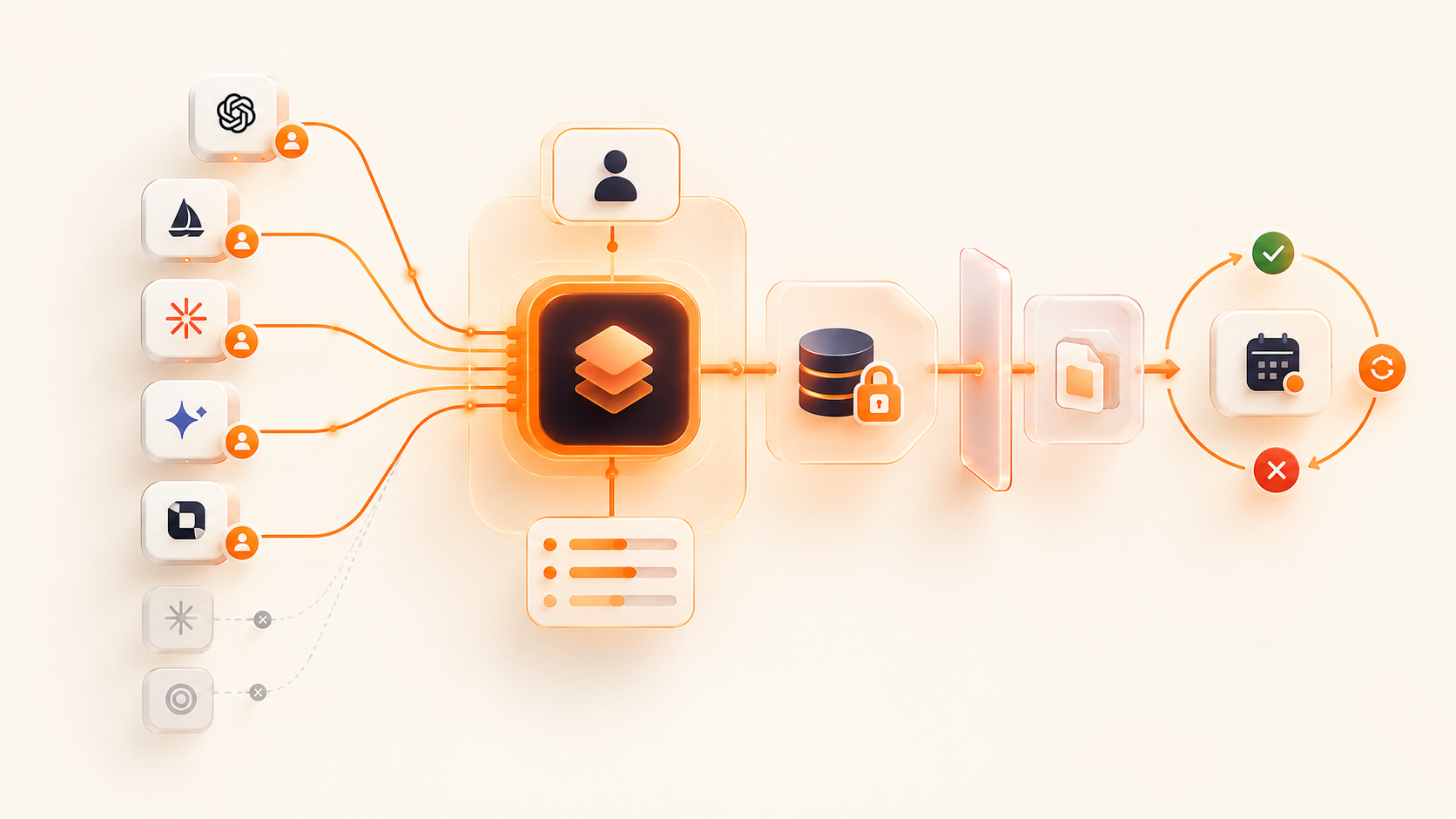
Short answer: An enterprise intelligence layer is the governed, continuously updated context between your company’s systems and the AI agents that use them. It connects raw records to business meaning: what an object is, who owns it, which source is authoritative, what it costs, who may access it, and which actions are allowed.
A model can read a database. An intelligence layer helps it understand the business.
This distinction matters because the same question can require different answers. “Which tools should we cut?” might mean unused licenses to IT, upcoming renewals to procurement, cash savings to finance, or workflow risk to an operator. A model without company context picks an interpretation. An agent with an intelligence layer can resolve the requester, definitions, live evidence, and policy before it answers or acts.
Enterprise intelligence layer: a definition
An enterprise intelligence layer is a shared, machine-readable model of a company’s entities, relationships, rules, and current operating state, served to people and AI systems with permissions and provenance attached.
It normally sits between systems of record — finance, identity, email, CRM, HR, support, code, and analytics — and the assistants or agents trying to reason across them.
The category is still forming. Microsoft describes its enterprise intelligence layer as a continuously updated understanding shared by Copilot and agents. DataHub uses “context layer” for governed infrastructure that combines technical metadata with business knowledge. Phase2 frames it as an architectural discipline for reliable, traceable AI. The labels differ. The job is consistent: make company context usable at inference time.
Why a better model is not enough
Frontier models are increasingly interchangeable for ordinary enterprise tasks. Your internal reality is not.
An AI system fails inside a company for reasons that model benchmarks barely measure:
- Identity is ambiguous. “Claude” may refer to a vendor, a plan, an API, three internal agents, and six card transactions.
- Definitions conflict. Finance and engineering may calculate “AI spend” differently.
- State changes. A contract, owner, permission, or budget can become stale between two prompts.
- Evidence is scattered. The invoice is in email, usage is in the browser, ownership is in the identity provider, and policy is in a document.
- Answers become actions. Recommending that a license be removed is low risk. Removing it without checking workflow dependencies is not.
Retrieval helps an agent find text. It does not automatically resolve identity, reconcile conflicting sources, enforce policy, or maintain operational state. Those are context problems.
What belongs in the layer
A useful enterprise intelligence layer usually contains six kinds of context.
1. Entities
People, teams, vendors, applications, contracts, agents, models, data sources, projects, and accounts. Each real-world thing needs a stable identity even when several systems name it differently.
2. Relationships
Who owns an app. Which team uses it. Which agent calls which model. Which contract governs which subscription. Which workflow depends on which tool. The graph matters because most enterprise questions cross systems.
3. Definitions
Agreed meanings for terms, metrics, and statuses. A definition should include its owner, source, calculation, and effective date — not just a sentence in a glossary.
4. Live operating state
Usage, spend, permissions, incidents, renewals, limits, and recent changes. Context that was correct last quarter can be dangerous today.
5. Policy and authority
What the requester may see. What the agent may do. Which actions need approval. Which source wins when two systems disagree.
6. Provenance and feedback
Where an answer came from, when the source was observed, and what changed after an action. Without provenance, mistakes are hard to audit. Without feedback, the layer never improves.
How it differs from adjacent layers
| Layer | Primary job | What it does not solve alone |
|---|---|---|
| Data warehouse | Store and query historical data | Business meaning, permissions, and operational action |
| Data catalog | Help people discover data assets | Runtime context assembled for an agent |
| Semantic layer | Standardise metrics and business definitions | Ownership, policy, changing state, and actions |
| Knowledge graph | Represent entities and relationships | Freshness, trust, policy enforcement, and execution |
| RAG pipeline | Retrieve relevant content for a prompt | Entity resolution, authority, and durable state |
| Enterprise intelligence layer | Serve governed business context to people and agents | It still needs the source systems above as evidence |
These are not competing products. They are ingredients. A semantic layer, catalog, and graph can all feed an intelligence layer. The difference is that the intelligence layer assembles the context an agent needs for a specific decision, at the moment it needs it.
How an enterprise intelligence layer works
- Ingest signals. Connect systems of record and capture structured and unstructured evidence.
- Resolve entities. Decide when two records refer to the same person, vendor, tool, agent, or contract.
- Build the graph. Link entities to owners, teams, spend, usage, policies, and workflows.
- Attach trust. Record source, freshness, confidence, and authority for every important claim.
- Serve context. Expose the relevant slice through search, APIs, or standards such as MCP — filtered for the requester and task.
- Control actions. Check policy, approvals, and blast radius before an agent writes back to a system.
- Learn from outcomes. Record corrections and results so future answers use better evidence.
The output is not one giant prompt. It is a small, authorised package of current context assembled for one decision.
The software and AI spend example
Software operations expose the problem clearly. A company may have an accounting transaction for “ANTHROPIC,” browser activity on claude.ai, API usage under a cloud account, a contract in someone’s inbox, and internal agents with informal names. None of those systems holds the whole answer.
ELI builds the enterprise intelligence layer for this part of the business. It connects software and AI spend to the people, agents, teams, usage, contracts, and workflows behind it. Its context graph is assembled from sources including inbox discovery, accounting data, browser usage, and native integrations.
That changes the questions you can ask:
- Which AI tools are we paying for but not using?
- Which agents drove the increase in model spend?
- Who owns this renewal, and what workflow depends on it?
- Which products overlap, and what would break if we removed one?
- Can this agent spend another $500 without approval?
A spend dashboard can show a total. An intelligence layer explains the total, connects it to operating reality, and gives an authorised agent enough context to act.
How to build one without boiling the company
Do not begin by indexing everything. Begin with one repeated decision where missing context is expensive.
- Name the decision. For example: “Should we renew this software contract?”
- List the evidence. Contract terms, recent usage, cost, owner, alternatives, dependencies, and cancellation policy.
- Choose authority. Decide which source wins for each field and how stale it may be.
- Model the entities. Start with the smallest graph that can answer the question.
- Make uncertainty visible. Missing ownership should produce “unknown,” not a confident guess.
- Keep action supervised. Let the agent draft the recommendation before it can cancel the contract.
- Measure the outcome. Track whether the decision saved money, avoided risk, or created rework.
Then add the next decision. The graph compounds because the same entities — people, tools, contracts, agents, and policies — recur across workflows.
Frequently asked questions
What is an enterprise intelligence layer?
It is a governed, continuously updated model of a company’s entities, relationships, definitions, policies, and operating state. It gives AI systems the context required to answer accurately and act safely across enterprise systems.
Is an enterprise intelligence layer the same as a context layer?
The terms overlap. “Context layer” usually emphasises the infrastructure that packages meaning and evidence for AI at runtime. “Enterprise intelligence layer” often describes the broader system, including entity resolution, governance, operational state, agent access, actions, and feedback.
Is it the same as a knowledge graph?
No. A knowledge graph is a useful structural component. An enterprise intelligence layer also manages freshness, authority, permissions, provenance, task-specific retrieval, and controlled actions.
Does every company need one?
Not as a standalone platform. A company needs the capability when AI must reason across several systems, definitions differ by team, or an agent can take consequential action. The higher the cost of a wrong answer, the more explicit the layer should be.
Where should you start?
Choose one high-frequency decision, map the evidence and authority it requires, then connect only the systems needed to support it. Expand from verified outcomes rather than from a company-wide data collection project.
The durable advantage is company context
Models will keep getting cheaper. Generic intelligence will keep spreading. Your durable advantage is the operating context the model cannot get from anywhere else: how your company defines things, how work actually moves, who owns what, and which decisions worked before.
The enterprise intelligence layer turns that context from scattered institutional memory into infrastructure. ELI starts where the cost is already visible — your software and AI estate — and turns every app, agent, owner, and dollar into a graph you can query and govern.